In this challenge, you’ll write a function that removes duplicate values from a list while preserving the original order. This is a common real-world problem and a great exercise in thinking beyond the most obvious solution.
Your Task
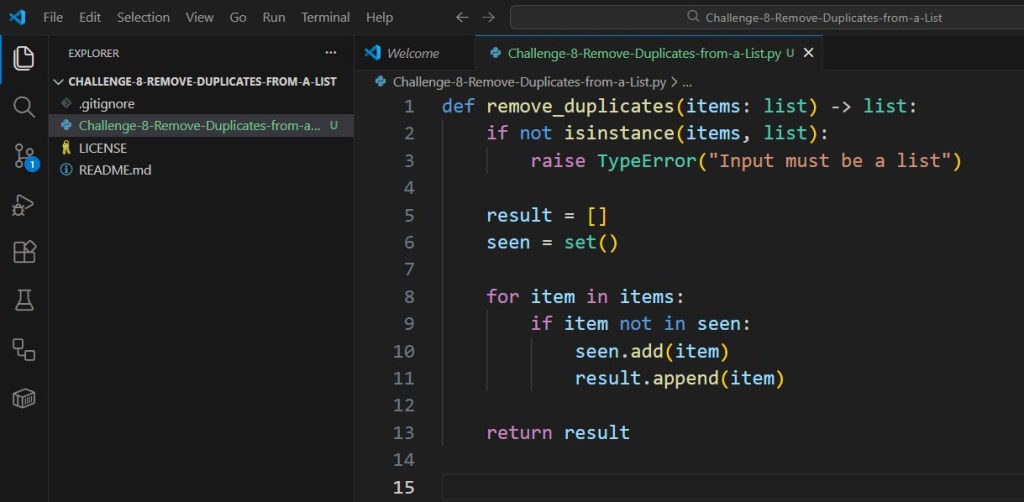
Write a function that accepts a list and returns a new list containing only unique elements, in the order they first appear.
Function Signature
def remove_duplicates(items: list) -> list:
    …
Rules
- The input must be a list.
- Preserve the original order of elements.
- Return a new list (do not modify the input list).
- Raise a
TypeErrorif the input is not a list.
Examples
remove_duplicates([1, 2, 2, 3]) →    [1, 2, 3]
remove_duplicates(["a", "b", "a"]) → ["a", "b"]
remove_duplicates([1, 1, 1, 1]) →    [1]
remove_duplicates([]) →              []
Invalid Input Examples
remove_duplicates("abc") → TypeError
remove_duplicates(None) →  TypeError
remove_duplicates(123) →   TypeError
Hints (Optional)
- You’ll need a way to track which items you’ve already seen.
- A simple loop often works better than clever one-liners.
- Think about why using
set()directly might not be enough.
What These Tests Enforce
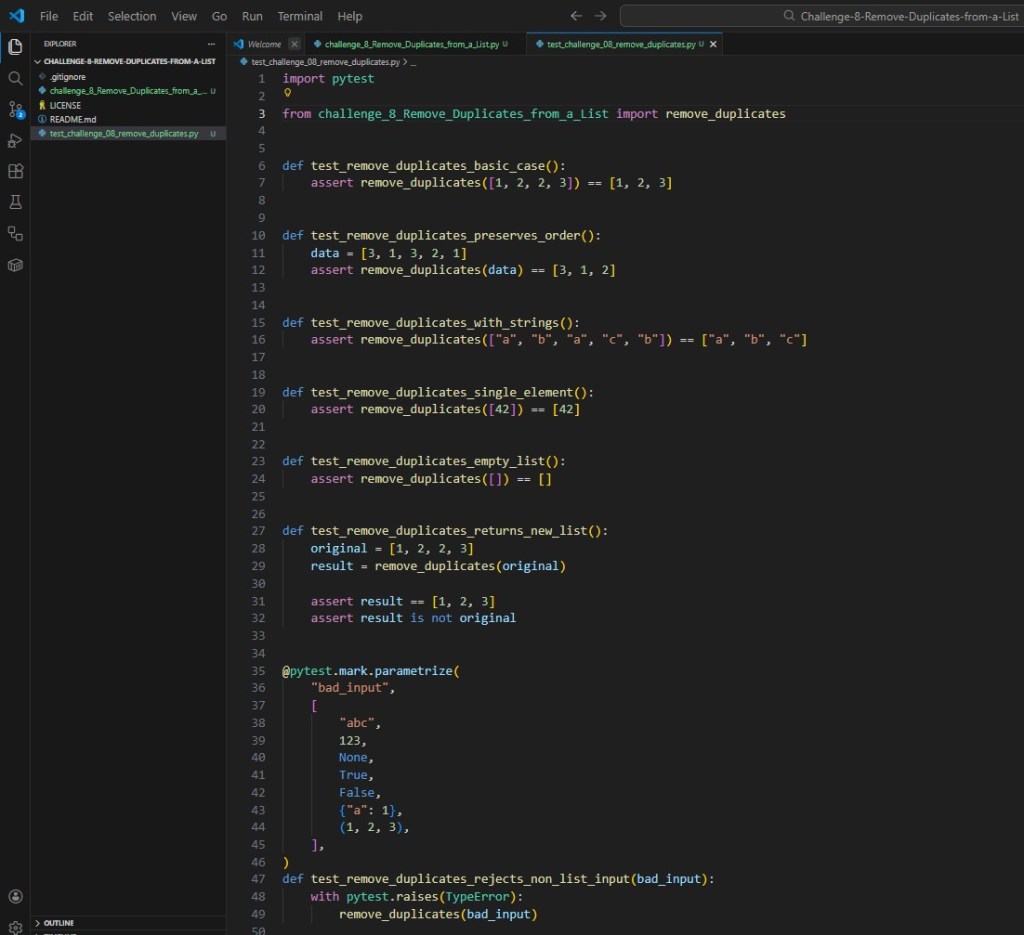
✔️ Order is preserved
✔️ Duplicates are removed correctly
✔️ Empty lists handled cleanly
✔️ New list is returned (no mutation)
✔️ Strict type checking for input
This keeps the challenge:
- Predictable
- Beginner-friendly
- Correct by design
What This Challenge Teaches
- Iterating through lists
- Tracking state (
seen) - Preserving order
- Understanding trade-offs between data structures
- Writing clean, predictable functions
Bonus Challenges
- Support lists with unhashable items (e.g. lists or dictionaries)
- Compare performance with a
set()-only solution - Write a version that modifies the list in place
Why This Matters
In real applications, order often matters. This challenge helps you move beyond “what works” to “what works correctly for the problem.”
🔗 View reference solution on GitHub
(After you’ve tried the challenge)
👉 Next Challenge → Find the Second Largest Number in a List
Want more practical Python challenges?
Subscribe to the Solve With Python newsletter and get new problems delivered to your inbox.
 SolveWithPython